C.A.R.E.4Paws and our pandemic response on KSBY

C.A.R.E.4Paws and our pandemic response on KSBY

The COVID-19 pandemic has made finances tight for many people. Pet ownership isn’t cheap between vet visits, food and supplies but a local non-profit is offering help to make sure once we clear the shelters, pets never end up back there.

Shelters, rescue groups, breeders and pet stores all report higher consumer demand than there are pets to meet it in 2020.

Our newfound time at home has people bringing home four-legged companions.

However, the pandemic has also brought financial challenges for millions of Americans and the expense of pet care means some newly adopted animals may end up back at the pound.

Isabelle Gullo’s non-profit, C.A.R.E. 4 Paws, is saving pets and pocketbooks on the Central Coast during these tough times.

“C.A.R.E. 4 Paws was started in 2009 with a goal to reduce pet overpopulation keep pets with their families for life,” Gullo said. “We welcome anybody to come. If they are struggling, we want to be able to help.”

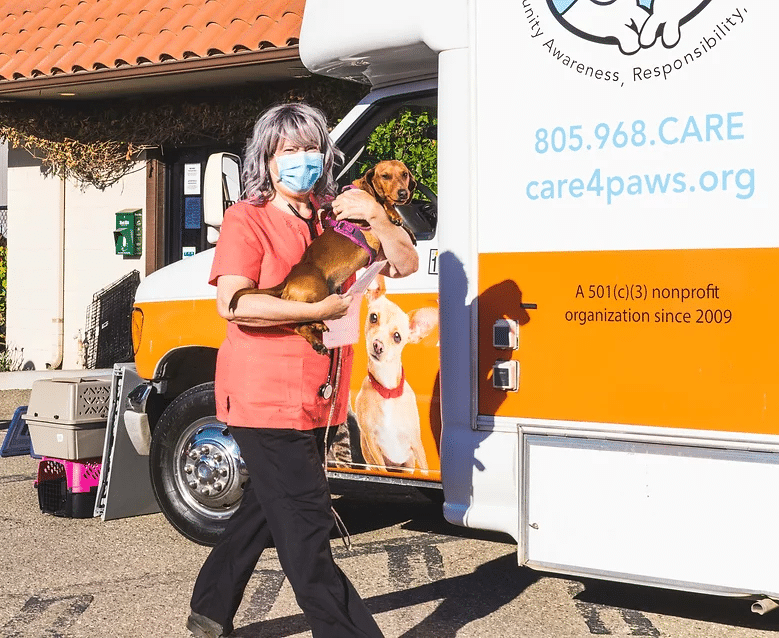
They offer low-cost vet services out of a mobile clinic.

“Now, we are running our clinic four to five times a week throughout the county so we’re all the way from Santa Barbara up to Santa Maria,” said Gullo.

Gullo says C.A.R.E. 4 Paws has provided as many services so far in 2020 as they did in all of 2019.

“The line of people that we see here every time we run our mobile clinic is just a sign of the times. People need our help,” she said.

Inside the mobile clinic, a team of highly-trained vet techs and Dr. Tom Thompson performs free spay and neuter operations and other services for people’s pets.

Christopher Valdez brought his four-month-old puppy Blu to C.A.R.E. 4 Paws for a surgery he says would have cost him $3,000 at a regular veterinarian’s office. C.A.R.E. 4 Paws will take care of Blu for $150.

“They do a great job for a low cost,” Valdez said.

Santa Maria resident Tihanna Portis has been grateful to C.A.R.E. 4 Paws since before COVID-19.

“I came to them before with two of my cats for their shots and they were just way cheaper,” Portis said. “[They are] wonderful and super quick and super friendly!”

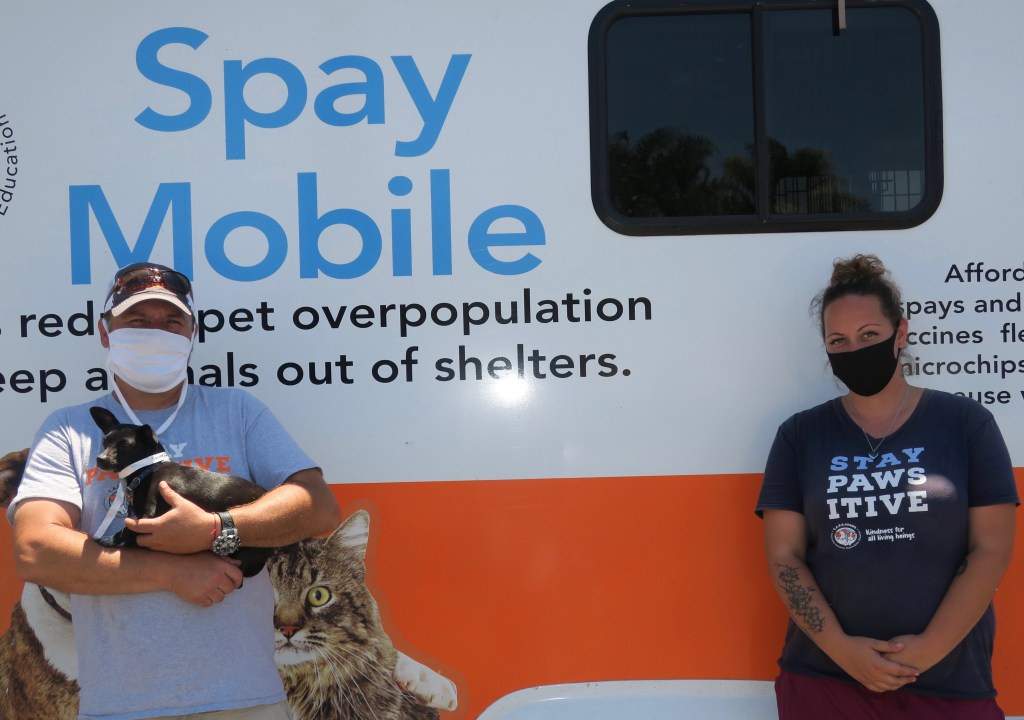
Walk-ups are welcome for vaccines, microchipping, flea control and pet food pick-up. Appointments for procedures and exams can be made over the phone.

Though the end of September, the non-profit is accepting new, unopened dog and cat food for their pet food drive to help meet the growing need.

“We are distributing about four tons of cat food every week throughout the county and to compare, in 2019, we distributed about 2 tons in the whole year,” Gullo said.

C.A.R.E. 4 Paws is helping the Central Coast clear the shelters and keep them clear by providing our furry family members with the care they deserve in exchange for all the love they give us.

“We are so excited to see all these pets being adopted through the pandemic and we really want them to be able to stay in their homes and not be returned to the shelter due to lack of resources so we’re here,” said Gullo.

Visit the C.A.R.E. 4 Paws website to learn more about their mobile vet clinic schedule and how to support the organization.


Original Article:

https://www.ksby.com/news/local-news/clear-the-shelters-non-profit-helps-people-pets-struggling-during-covid-19-pandemic

COVID-19 financial strain on Santa Barbara County pet owners sends need for help skyrocketing

COVID-19 financial strain on Santa Barbara County pet owners sends need for help skyrocketing

Failed businesses, job losses and temporary layoffs caused by the COVID-19 pandemic have hit families hard in Santa Barbara County, and the financial strain is even greater among pet owners who may have to choose between feeding and providing medical care for their dogs and cats or giving them up to a shelter.


The effort to keep pets a part of the family has led one nonprofit organization to distribute 100 times as much pet food to those in financial straits as it did before the pandemic struck.


It’s also increased the demand for assistance with veterinary care and spaying and neutering.


“There’s been a tremendous jump since the first of COVID,” said Isabelle Gullo, executive director of C.A.R.E.4Paws, the countywide organization she co-founded with Carlos Abitia in 2009. “We’ve always had our [food assistance] program. But with the amount of food we’re distributing now, we had to reinvent it.”


In all of 2019, C.A.R.E.4Paws gave out 2 tons of pet food to seniors and other low-income pet owners who needed help, Gullo said.


Since the COVID-19 pandemic struck, the organization has been distributing an average of 4 tons of pet food and kitty litter per week, which could put 2020’s total distribution somewhere approaching 200 tons.


090220 care for paws 002

Anezka Jahner, a volunteer from Santa Barbara, helps distribute donated pet food Wednesday at the C.A.R.E.4Paws mobile clinic at the Eagles Lodge in Santa Maria. The COVID-19 pandemic has increased the demand for help with pet food by nearly 100 times last year’s level.

“The majority of that is food,” Gullo said Monday. “The kitty litter is mostly just going to the seniors who are stuck at home that we deliver pet food to.


“Some weeks it’s 3 tons, some weeks it’s 5 or 6 tons, but the average is about 4 tons a week,” she added.


In addition to dog and cat food, the organization is now distributing rabbit and bird food as well as chicken feed in the more rural areas of the county.


Most of the pet food is distributed at weekly events held in conjunction with community partners — Foodbank of Santa Barbara County, People Helping People in Santa Ynez Valley and the senior centers in Los Alamos and Guadalupe.


Food is also distributed at each stop of the organization’s mobile clinic, which provides free and low-cost veterinary care for senior, low-income, disabled and homeless pet owners and also has seen increased demand.


090220 care for paws 006

Pet owners wait socially distanced in line with pets at the C.A.R.E.4Paws mobile clinic for veterinary services and assistance with pet food in September in Santa Maria. The nonprofit organization was handing out about 100 times more food this year than last year to assist pet owners financially strapped because of the COVID-19 pandemic.

Gullo said the organization had expected to provide veterinary care to 1,200 animals in 2020, but at the current rate, the total will be about 1,700.


“We’ve been providing more mobile clinic services every year, but right now we’re already meeting our annual totals,” she said. “With COVID, the need is greater than it’s ever been.”


Low-cost spaying and neutering are also provided through the mobile clinic, and C.A.R.E.4Paws budgeted for 1,400 of those surgeries this year.


But the number reached 1,200 in the first eight months, and, if the organization can find enough funding, the total could reach more than 1,900, Gullo said.


“We don’t think this need will decline anytime soon,” she said. “We really want to keep pets with their owners through COVID and after that.”


090220 care for paws 003

Miriam Torres holds 10-week-old Casper, a Portuguese podengo brought to the C.A.R.E.4Paws mobile clinic in Santa Maria for its second round of vaccinations Wednesday. The organization expected to care for 1,200 pets this year but COVID-19 is pushing that number toward 1,700.

To help meet the unprecedented demand, C.A.R.E.4Paws on Tuesday launched a monthlong Pet Food & Matching Donation Drive, asking the community to leave dog and cat food and kitty litter at one of the drop-off sites set up at partner organizations.


Monetary donations made during the drive will be matched dollar-for-dollar up to $10,000 through Sept. 30, Gullo said.


Donated funds will be allocated toward the organization’s most pressing needs, whether that’s for pet food, critical services provided in C.A.R.E.4Paws’ mobile veterinary clinic or assistance for pets of domestic violence survivors, she said.


C.A.R.E.4Paws’ COVID efforts in Santa Maria featured on KEYT

C.A.R.E.4Paws’ COVID efforts in Santa Maria featured on KEYT

SANTA MARIA, Calif. – C.A.R.E.4Paws is seeing the need for animal services double in Santa Maria during COVID-19.

During the past 6 weeks C.A.R.E.4Paws saw a demand for services higher in Santa Maria than any other city in the county.

They say this is due to less veterinarian services available.

There are also more people out of work who just can’t afford animal services during the pandemic.

C.A.R.E.4Paws is expanding its services with two surgical trucks several times a week in Santa Maria.

They will be offering animal services at the Santa Maria Eagles 688 College Drive on Wednesday in Santa Maria from 10:00 a.m. to 1:00 p.m.

Low-cost services during this walk-in clinic include:

  • Vaccines
  • Topical flea treatment
  • Dewormer
  • Microchipping
  • Nail trims
  • Emergency pet food distribution

Original Article:

Animal service needs double in Santa Maria during COVID-19 pandemic

C.A.R.E.4Paws’ COVID-19 response and services in the Independent

C.A.R.E.4Paws’ COVID-19 response and services in the Independent

With the economic hardship brought on by COVID-19, many pet owners throughout our county would be struggling to meet the basic needs of their pets if it weren’t for the remarkable work of C.A.R.E.4Paws, which has stepped up its food assistance, veterinary care, and other programs. 

A novel program fosters pets of victims of domestic violence while another does outreach to ensure the pets of people who are homeless receive all they need. All assistance is geared to keeping pets healthy and with their owners.

During COVID, C.A.R.E.4Paws has been distributing an astonishing amount of pet food and cat litter — about four tons each week —through events hosted by Foodbank of Santa Barbara County and other organizations, through its mobile clinic, and directly to seniors and people with disabilities (including through a 2-1-1 emergency hotline). This level is unprecedented — in all of 2019, it distributed a total of two tons — and critical: According to Executive Director and Cofounder Isabelle Gullo, the provision of food can mean the difference between a pet staying with its family and ending up in a shelter. 

There has also been a big spike in demand for veterinary care. While the hard economic times have led to an increased need for free and low-cost services, at the same time the clinics at the Santa Barbara Humane Society (which now includes the Santa Maria Valley Humane Society) have been closed, as has S.B. County Animal Services’ clinic. While these have shuttered, C.A.R.E.4Paws has heroically ramped up its services, adding clinic days and working longer hours to meet the increased demand. 

Through its mobile clinic, C.A.R.E.4Paws offers to low-income and homeless owners free spay/neuter services and low-cost or free veterinary care, including wellness exams, vaccines, and wound care. The clinic visits Santa Barbara, Santa Maria, and Lompoc on a weekly basis, and also goes to Goleta, New Cuyama, Guadalupe, and the Santa Ynez Valley. As of June 1, C.A.R.E.4Paws had performed 726 spay/neuter surgeries this year (up 22 percent from the same period last year). It anticipates providing other types of veterinary care services to 1,500 pets this year (compared to 1,070 in 2019).

Community Medicine & Spay/Neuter Outreach Manager and Co-founder Carlos Abitia and Vet Tech Cristy Culligan.

When veterinary services are beyond the scope of what C.A.R.E.4Paws’s clinic provides or when an urgent need cannot be timely met because of the clinic’s current location, C.A.R.E.4Paws refers owners to one of a dozen veterinary clinic partners, most of whom offer reduced rates, including Animal Medical Clinic in Carpinteria and Advanced Veterinary Specialists (AVS) in Santa Barbara. To the extent its budget allows, C.A.R.E.4Paws covers part or all of the costs.

Through COVID, C.A.R.E.4Paws continues its outreach and assistance program for homeless pet owners, which provides food, other supplies, and veterinary care. According to Gullo, “For so many community members, and especially homeless pet owners and seniors, pets are a lifeline that provide much-needed companionship and emotional support.” The key to reaching homeless pet owners is its Pet Resource Centers located throughout the county, where owners can pick up food and supplies and sign up for the mobile clinic. In South County, the centers are at the S.B. Rescue Mission, Unity Shoppe, Noah’s Anchorage, PATH Santa Barbara, the Salvation Army, and Isla Vista Community Service District. 

A new and very timely program is the Safe Haven Domestic Violence Assistance Program, launched in February with Domestic Violence Solutions (DVS). Pet owners exposed to domestic violence can seek emergency shelter for themselves at DVS, while C.A.R.E.4Paws arranges immediate, anonymous foster care for their pets. Victims also can come in directly, through law enforcement, and through the District Attorney’s Office Victim-Witness Assistance Program. Already, the program has taken in more than a dozen dogs and cats. Some pets have been reunited with their owners which, Gullo related, is “such a wonderful, heartwarming experience.”

Regarding all of C.A.R.E.4Paws programs, Gullo stresses that it’s only through the collaboration of staff, volunteers, individual donors, business donors, foundations, and community partners that C.A.R.E.4Paws has been able to rise to the incredible challenge that COVID times has presented. “Everyone wants to help make a difference, and so it’s truly community supporting community.” 

Lemos Feed and Pet Supply donated several tons of food and has given big discounts on food purchased. Montecito Pet Shop has also donated and offered discounts, and Healthy Pet has donated, as well. Dioji K-9 Resort & Athletic Club donates the use of its Santa Barbara facility to store and package food, and it, along with ResQcats and Animal Shelter Assistance Program (ASAP), have raised significant funds. 

With the drastic increase in demand anticipated to continue, C.A.R.E.4Paws is in need of further contributions to sustain its programs. It also needs foster families and always welcomes volunteers. 

C.A.R.E.4Paws operates countywide, with about 30 percent of assistance in South County, 5 percent mid-county, and 65 percent North County. Its small staff is supplemented by about 60 volunteers. For more info or to donate, go to care4paws.org.

Original Article:

C.A.R.E.4Paws Steps Up Pet Assistance in COVID Times

Our mobile clinic and food distribution featured on KEYT

Our mobile clinic and food distribution featured on KEYT

SANTA BARBARA, Calif. – You may find yourself short of the cash you need to care for your pet during the ongoing crisis.

One group is stepping up to help.

With a fully staffed, large mobile care center, C.A.R.E.4Paws is setting up in different locations throughout Santa Barbara County to provide services. 

Thursday in Santa Barbara, pets were getting important shots outside of the vehicle, right on the spot.

Inside, there were several pets going through some emergency surgeries, and wellness checkups.

Many pet owners and their pets came away with smiles and wagging tails.

Owner Carlos Abitia says, “we are really happy to help when it counts, when it matters. Right now people are strapped for money, in some cases, they have no paycheck, so we are here to help.”

Free pet food is also available.

“Most of the services are free or for a very very low cost,” said Abitia.

C.A.R.E.4Paws is also offering pet food for the homeless, along with pet checkups. In domestic violence cases, they respond with a vet and shelter services.

For more information on their set up locations, dates and times go to: C.A.R.E. 4 Paws.

Original Article:

Low-cost pet care, wellness checks offered during stressful times in Santa Barbara

Safe Haven on Edhat

Safe Haven on Edhat

Source: C.A.R.E.4Paws

With the lockdown orders and heightened emotional and financial stresses caused by COVID-19, domestic violence is more prevalent than ever. Family violence affects not just adults and children, but pets, too. So many of our community members and their animals are being harmed in a place where they should feel safest: their own home. C.A.R.E.4Paws and local agency partners are here to provide a refuge

C.A.R.E.4Paws’ Safe Haven program ensures domestic violence victims can find safety for their pets when they leave an abusive situation. Pet owners exposed to domestic violence can seek emergency shelter with their companion animals through Domestic Violence Solutions (DVS) and C.A.R.E.4Paws will arrange for immediate, anonymous foster care or boarding for the pets. Victims and law enforcement can also contact C.A.R.E.4Paws directly for support.

Family violence statistics were staggering even before the social isolation enforced by COVID-19, making a program like Safe Haven desperately needed. Isolation and lack of social support contribute to the increased risk of domestic violence. Pets are often used as a way to control the family and may prevent members from leaving out of fear something will happen to the animal. In surveys of women entering domestic violence shelters, as many as 85 percent reported that their pets had been threatened, tortured or killed by their partners.

“Now more than ever, we need to provide a safety net for those in need of support,” says C.A.R.E.4Paws’ Executive Director and Cofounder Isabelle Gullo. “Safe Haven will protect and care for pets until they can be reunited with their loving owners. We hope this encourages community members to reach out for help and seek safety with their companion animals.”

Pets enrolled in Safe Haven are sheltered with love and also have access to veterinary care in C.A.R.E.4Paws’ mobile veterinary clinic as well as behavioral training, if needed.

“The partnership between Domestic Violence Solutions and C.A.R.E.4Paws has become an essential part of the services we offer to shelter clients who have pets,” says Jan Campbell, Executive Director of Domestic Violence Solutions. “Knowing that their beloved pets are safely and confidentially housed helps to mitigate trauma suffered by domestic violence survivors and their families.”

Other critical Safe Haven collaborators include C.A.R.E.4Paws’ partners in the Animal Welfare Alliance of Santa Barbara County—Animal Shelter Assistance Program (ASAP), Dog Adoption Welfare Group (DAWG) and Santa Ynez Valley Humane Society—as well as Santa Barbara County District Attorney’s Office Victim-Witness Assistance Program, whose advocates are specially trained to help victims of abuse.

“Our goal is to support crime victims and witnesses as they move from victim to survivor to empowered,” says Santa Barbara County District Attorney Joyce E. Dudley. “We know a significant step toward that is to help them and their loved ones (including their pets) feel safe. Toward that end we proudly partner with C.A.R.E.4Paws and Domestic Violence Solutions.”

For more information about C.A.R.E.4Paws’ Safe Haven program, visit care4paws.org/safehaven or contact C.A.R.E.4Paws at safehaven@care4paws.org or (805) 335-7524.

For a quick guide to all services provided to pet owners in need during COVID-19, as well as ways in which community members can help others during this crisis, go to care4paws.org/services/.

Original Article:

https://www.edhat.com/news/domestic-violence-victims-and-pets-need-safe-haven-right-now

C.A.R.E.4Paws food distribution and COVID-19 efforts in the News-Press

C.A.R.E.4Paws food distribution and COVID-19 efforts in the News-Press

by Dave Mason

Harley Grace, a Yorkshire terrier, loves to run circles around Luna, a Siberian husky.

They’re buddies.

“Luna acts like the mom to Harley,” Santa Maria resident Sal Medina told the News-Press.

The two dogs bring a lot of joy to Mr. Medina and his wife, Vivian, especially during the COVID-19 pandemic.

That’s why the couple is grateful to C.A.R.E.4Paws, which delivered free dog food to them.

Mr. Medina, 81, explained that the couple is low-income. Without the help from C.A.R.E.4Paws, “we would have to give up the dogs probably,” he said.

As the pandemic continues, C.A.R.E.4Paws is providing more free pet food than ever before, said Isabelle Gullo, the Santa Barbara County nonprofit’s executive director and co-founder.

“I would say we give away at least two tons of pet food and cat litter every week,” Ms. Gullo told the News-Press.

“We’ve always had a pet food delivery program, but it’s expanded to something we’ve never experienced before,” she said. “We are helping probably 100 or so seniors weekly with pet meals.”

C.A.R.E.4Paws is distributing pet food and other supplies such as cat litter to low-income residents, seniors, people with disabilities and the homeless. Ms. Gullo said. 

She noted the people served by C.A.R.E.4Paws are struggling more than ever to put food on their tables, let alone care for their pets.

“If we don’t reach out and provide a safety net, we’re going to see a lot more animals and the owners suffering,” Ms. Gullo said. She noted the goal is to keep pets with their owners and out of shelters.

In addition to deliveries, C.A.R.E.4Paws is helping about 500 pets a week through free food distribution at its mobile clinic and weekly events in Solvang, Guadalupe and Los Alamos, Ms. Gullo said. (See the FYI box for the schedule.) She added that C.A.R.E.4Paws is hoping to add other distribution events.

Ms. Gullo also noted C.A.R.E.4Paws is distributing pet food to the Bulleton Senior Center, which adds it to its food for humans in its Meals on Wheels program. And C.A.R.E.4Paws started a partnership last week with Meals on Wheels in Santa Barbara, which tells its clients about the pet food program.

C.A.R.E.4Paws also distributes free pet food at its resource centers, located at sites throughout the county. They include Unity Shoppe in Santa Barbara, the Salvation Army, the Santa Barbara Rescue Mission and the PATH Santa Barbara homeless shelter.

“For most homeless pet owners, their pets are a lifeline, their sole companionship,” Ms. Gullo said. 

Ms. Gullo also noted C.A.R.E.4Paws began collaborations during the pandemic with the Foodbank of Santa Barbara County and the 211 hotline. “We get referrals for seniors who need pet food delivered to them as well as human food.”

Other partnerships include ones with Santa Ynez Valley People Helping People and the Los Alamos Foundation. (See the FYI box.)

Ms. Gullo added that C.A.R.E4Paws provides help with affordable, critical veterinary care.

And the nonprofit helps pet owners affected by domestic violence through Safe Haven, a program that C.A.R.E4Paws launched Feb. 1 in partnership with Domestic Violence Solutions for Santa Barbara County. C.A.R.E.4Paws arranges for temporary foster homes or boarding for pets so owners don’t have to leave their pets behind or stay in a violent relationship because of an animal.

Ms. Gullo explained how the nonprofit has improved that assistance.

Previously, the nonprofit responded only to referrals from Domestic Violence Solutions, she said. “Now people can contact us directly for help.” (Go to care4paws.org/safehaven.)

Ms. Gullo added those affected by domestic violence also can get C.A.R.E.4Paws’ help by contacting services such as the Santa Barbara County District Attorney’s Office’s Victims-Witness Assistance Program. 

As C.A.R.E4Paws works to keep pets with their owners, the nonprofit welcomes donations of pet food. Ms. Gullo said there’s an Amazon wish list at care4paws.org.

“But I would say the biggest way people can help is through monetary donations that we can then use to buy pet food and supplies,” she said.

Ms. Gullo noted C.A.R.E.4Paws last week received a $15,000 donation from Montecito couple Heather and Tom Sturgess. 

Ms. Gullo said the money went for the nonprofit’s purchase at Lemos Feed & Pet Supply. She added that the Santa Barbara County business provided significant discounts and its own donations of food, which greatly increased the total amount.

The C.A.R.E4Paws executive director and co-founder noted that pets today are providing much needed emotional support. 

“It’s really important that we keep pets with their owners throughout the pandemic.”

FYI

C.A.R.E.4Paws offers pet food, cat litter and other supplies for pet owners in need. Go to care4paws.org/petassistance, which features pet food drop-off locations.

Pet food and supplies are also given away at C.A.R.E.4Paws’ mobile clinic. See the schedule at care4paws.org/clinicservices.

The food and supplies are also distributed from 1 to 3 p.m. Tuesdays at Mission Santa Inés, 1760 Mission Drive, Solvang, in a partnership with Santa Ynez Valley People Helping People. Another distribution takes place 1 to 3 p.m. Thursdays at the Guadalupe Senior Center, 4545 10th St., Guadalupe, in a partnership with the Foodbank of Santa Barbara County. And a third distribution is set for 11 a.m. to 1 p.m. Saturdays at the Los Alamos Valley Senior & Community Center, 690 Bell St., Los Alamos, in a partnership with the Los Alamos Foundation.

C.A.R.E.4Paws also provides pet food for the Buellton Senior Center, which distributes it along with food for humans in its Meals on Wheels program. And C.A.R.E.4Paws has started a partnership with Meals on Wheels in Santa Barbara.

To make a donation, go to care4paws.org/help. Donations of pet food are welcome, but C.A.R.E.4Paws prefers monetary contributions.

In addition to pet assistance, C.A.R.E.4Paws helps pet owners affected by domestic violence. For more information, go to care4paws.org/safehaven.

For more information, contact the nonprofit at 805-968-2273 or info@care4paws.org.

Original Article:

Unprecedented: C.A.R.E.4Paws provides record-breaking amounts of free pet food during pandemic

Safe Haven assistance during COVID-19 in the Santa Maria and Santa Ynez Times and Lompoc Record

Safe Haven assistance during COVID-19 in the Santa Maria and Santa Ynez Times and Lompoc Record

By Lisa Andre

In response to emotional and financial stress caused by shelter-at-home orders relating to COVID-19, C.A.R.E.4Paws‘ Safe Haven program has joined forces with agency partners to ensure domestic violence victims have a safe place for their pets when leaving an abusive situation.

The organization’s executive director and co-founder, Isabelle Gullo, said that family violence affects not just adults and children, but pets as well – putting them in harm’s way.

“Now more than ever, we need to provide a safety net for those in need of support,” said Gullo. “Safe Haven will protect and care for pets until they can be reunited with their loving owners. We hope this encourages community members to reach out for help and seek safety with their companion animals.”

Gullo said that family violence statistics were staggering even before shelter-at-home orders were enforced, and now with the added isolation and lack of social support, risk of domestic violence has increased.

She said that 85% of women who were surveyed upon entering domestic violence shelters, reported that their pets had been threatened, tortured or killed by their partners. And for many victims, that may prevent them from leaving out of fear something will happen to the animal.

Pet owners who are exposed to domestic violence can seek emergency shelter with their companion animals through Domestic Violence Solutions (DVS) and C.A.R.E.4Paws, who will arrange for immediate, anonymous foster care or boarding of their pets.

Jan Campbell, executive director of Domestic Violence Solutions, said the partnership between Domestic Violence Solutions and C.A.R.E.4Paws has become an essential part of the services offered to shelter clients who have pets.

“Knowing that their beloved pets are safely and confidentially housed helps to mitigate trauma suffered by domestic violence survivors and their families,” Campbell said.

She explained that pets enrolled at Safe Haven are sheltered with love and have access to veterinary care in C.A.R.E.4Paws’ mobile veterinary clinic, as well as behavioral training if necessary.

Currently adoption fees for all animals are just $10 and fostering opportunities are also available. 

Other critical Safe Haven partners include the Animal Welfare Alliance of Santa Barbara County — Animal Shelter Assistance Program (ASAP), Dog Adoption Welfare Group (DAWG) and Santa Ynez Valley Humane Society — as well as Santa Barbara County District Attorney’s Office Victim-Witness Assistance Program, whose advocates are trained to help victims of abuse.

For direct support, victims and law enforcement can contact C.A.R.E.4Paws’ Safe Haven program at safehaven@care4paws.org or call 805-335-7524. For more information about the program, visit care4paws.org/safehaven.

A quick guide to all services provided to pet owners in need during COVID-19, as well as ways in which community members can help others during this crisis, can be viewed at care4paws.org/petstrong.

Original Article:

https://syvnews.com/lifestyles/pets/c-a-r-e-4paws-offering-safe-haven-program-for-pets-exposed-to-domestic-violence/article_d3fbd9df-612d-5fb7-a720-cee0c43857e5.html

Pet Emergency Training for First Responders on KSBY

Pet Emergency Training for First Responders on KSBY

Santa Barbara County firefighters are going through a series of workshops teaching them how to handle and help injured pets and animals.

“Anything from the basics of assessing a pet’s health at the given time and then to providing things like fluid and CPR and wound treatment. It just helps bridge that gap that otherwise a pet might suffer or even die in an emergency situation,” said Isabelle Gullo, C.A.R.E.4Paws Executive Director and Co-Founder.

On Monday, the non-profit organization C.A.R.E.4Paws, alongside pet emergency hospital Advanced Veterinary Specialists, and dog trainer Brian Glen, hosted the first of 12 workshops.

According to Santa Barbara County Fire Department Battalion Chief Tom Himmelrich, first responders are not typically trained on how to handle or provide medical attention to pets such as cats and dogs.

However, that will no longer be the case for Santa Barbara County firefighters.

“This will just give us another tool to be able to better serve the community and animals and get them to better care,” said Himmelrich.

While the animals used in the training demonstrations are calm and easy to work with, that likely will change in the field when pets may be found in distress or pain.

“We are doing the best we can to prepare the first responders and firefighters for these different scenarios,” said Gullo.

The two-hour workshops consist of hands-on medical training, including everything from knowing how to give a cat or dog oxygen to learning how to properly bandage an injured leg was covered during the session.

“I learned how to put a quick muzzle on a dog by using a leash and that would just make it safer if we are concerned about a dog potentially biting us while we are trying to treat it,” said Himmelrich.

According to C.A.R.E.4Paws, pet first aid kits are in the works to be carried on fire engines and other emergency vehicles.

C.A.R.E.4Paws also has many other services they offer like free spays and neuters, as well as low cost veterinary care. To learn more, click here.

This was the fist of 12 upcoming workshops with the Santa Barbara County Fire Department.

According to the American Animal Hospital Association, one out of four animals would survive a life-threatening injury if just one first aid technique was used before the pet were to reach a veterinary hospital.

Original Article:

https://www.ksby.com/news/community/vista-semanal/local/santa-barbara-county-firefighters-learn-how-to-aid-injured-pets 

Pet Emergency Training for First Responders in the Santa Maria and Santa Ynez Times and the Lompoc Recorder

Pet Emergency Training for First Responders in the Santa Maria and Santa Ynez Times and the Lompoc Recorder

By Mike Hodgson:

Santa Barbara County firefighters will soon be better prepared to deal with injured pets they encounter after they receive training in a series of workshops that started Monday in Orcutt.


First responders with the County Fire Department will receive pet emergency training from Advanced Veterinary Specialists and dog trainer Brian Glen in a dozen free workshops covering 16 fire stations, said Isabelle Gullo, co-founder and executive director of C.A.R.E.4Paws.


Gullo said one out of four animals that die from life-threatening injuries would survive if just one first-aid technique was applied before the pet reached a veterinary hospital, according to American Animal Hospital Association.


But firefighters, rescue personnel and even paramedics and emergency medical technicians who are usually the first to arrive at a fire, crash or other emergency, are generally not trained to provide medical treatment to pets, she said.


So last November, the nonprofit organization launched Pet Emergency Training, or PET, for First Responders to teach them how to safely care for and treat pets they encounter in emergency situations.


Broad training

In the workshops, firefighters will learn how to recognize animals’ injuries, determine their severity and provide appropriate initial treatment before they can be picked up by officers from the Division of Animal Control.


“When a cat is burned, you can’t tell how badly injured it is until a couple of days later,” Gullo said. “By then, the organs are already shutting down.”


In addition to recognizing injuries and their severity, Dr. Andrea Wells, owner of Advanced Veterinary Specialists and an internal medicine specialist, said firefighters will receive at least an hour of hands-on medical training.

One dog’s animosity toward a mail carrier has led to the suspension of mail delivery for dozens of homes in a northwest Santa Maria neighborhood. The suspension began June 6 after the dog charged at a United States Postal Service carrier who was delivering mail to a neighboring home, according to Postal Service spokeswoman Meiko Patton.

“Immediate care and stabilization can be key to a successful recovery from injury,” Wells said.


The hands-on training will range from animal CPR, wound treatment and handling of broken limbs to how to provide fluids and other critical care to an overheated animal.


“We’re more involved with dogs injured in vehicle accidents than structure fires, so that’s very helpful for me,” said Capt. Cesar Martinez of County Fire Station 26, formerly Station 22, at the corner of Tiffany Park Court and Stillwell Avenue in Orcutt.


Firefighters will get to practice the various techniques with dogs and cats owned by Advanced Veterinary Specialists staff members.


During a visit to Station 26 on Friday, Gullo told Martinez and Capt. Lenny Maniscalco, from Station 30 in Solvang, that many of the procedures can be performed with equipment firefighters already use.


But she noted special pet first-aid kits are being prepared for firefighters to carry on every truck.


“They will have pet CPR masks of different sizes, things like that,” she said.


Most cats and dogs act differently when injured or in distress, so the animal trainer will provide techniques for safely capturing, handling and restraining pets to ensure they receive medical treatment or remove them from a dangerous situation.


Glen also will talk about dog psychology and how to deal with protective or aggressive dogs that can harm a first responder and prevent a pet owner from receiving timely critical care.


“Often we run into cases where [injured] people have got animals,” Maniscalco said. “That would help us understand in body language what [the animals] are feeling.”


Double benefit

Firefighter Sam Dudley, who’s assigned to Station 12 in Goleta, said the pet rescue training is a great opportunity for the department and the public.


“I think we recognize, as firefighters, these furry friends of ours are like part of the family,” he said. “We’re very excited to add another tool to our toolkit to serve the public.”


Dudley noted the training will have a dual benefit.


“Aside from being able to help the public, the department has two canines and we’re getting a third,” he said. “One is a live search dog — it searches for live individuals. One is an arson dog, an accelerant dog, that looks for evidence of arson.


“The new one, for which I will be the handler, is an emotional support canine,” he continued. “That dog will be able to provide emotional support for us as well as statewide.


“The suicide rate in fire departments is the same as — if not slightly higher than — it is in the military right now,” he said. “It’s become a real problem. County Fire understands the importance of having these emotional support dogs.”


Dudley said if one of the department’s three canines should be injured while in the field, firefighters will be able to use what they’ve learned in the workshops to treat the dogs and potentially save their lives.


Original Article:

https://santamariatimes.com/news/local/santa-barbara-county-firefighters-to-be-trained-in-pet-first/article_1cfd453a-1ed0-563e-9065-efa68d4dc560.html#tracking-source=home-top-story-1